

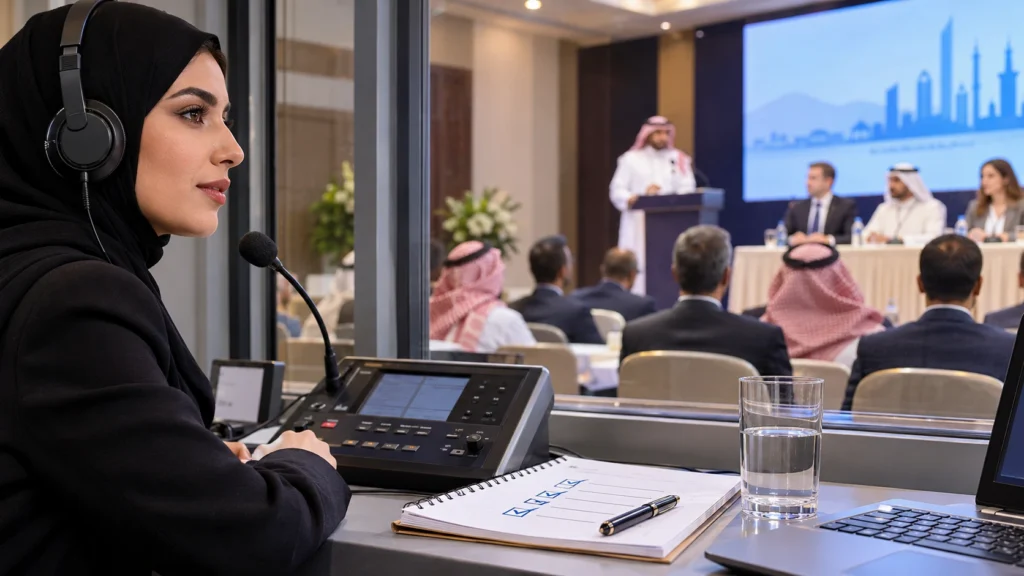
You have booked the venue, confirmed the speakers and sent the invitations. Then you realise a third of your audience, or your keynote speaker, will be speaking Arabic. Interpreting is often the last thing organisers plan and one of the first things attendees notice when it goes wrong.
This guide covers the types of conference interpreting, what equipment you need, how many interpreters to book and how to set everyone up for success.
Simultaneous or Consecutive?
Simultaneous Interpreting
Interpreters work from a soundproof booth and speak at the same time as the presenter. Listeners hear the interpretation through headsets. This is the standard for conferences, summits, AGMs and any event with more than a small group, because it adds no extra time to the programme.
Consecutive Interpreting
The speaker pauses every few sentences and the interpreter repeats the message. It needs no booth, but it roughly doubles the speaking time. It suits press conferences, small panels, award speeches and VIP meetings on the side of the main event.
Compare all formats on our interpretation service page.
How Many Interpreters Do You Need?
Simultaneous interpreting is mentally exhausting. Professional standards call for two interpreters per language direction, taking turns every 20 to 30 minutes. For a full day, plan on a team of two at minimum. If you need interpreting both into and out of Arabic on the same stage, discuss the setup with us so we can plan the booths and channels.
Equipment Checklist
- Interpreter booth, either full size or tabletop
- Interpreter consoles and microphones
- Headsets and receivers for attendees
- A clean audio feed from the main sound system
- A technician on site for the whole event
Check early whether your venue’s AV team can provide this, or whether it needs to be hired separately.
Hybrid and Virtual Events
Remote simultaneous interpreting lets interpreters work from a studio while attendees join online, choosing their language channel in Zoom or another platform. For hybrid events, the same audio can feed both the room and the stream.
Getting the Best Out of Your Interpreters
- Share slides, speeches, agendas and speaker bios at least a week ahead.
- Send a list of names, acronyms and technical terms.
- Ask speakers to talk at a natural pace and avoid reading quickly from scripts.
- Warn interpreters about any videos with sound, and share them in advance.
- Give the team a short briefing before doors open.
Match the Dialect to the Audience
Formal speeches are usually delivered in Modern Standard Arabic, which every educated Arabic speaker understands. For Q and A, workshops and networking, interpreters familiar with the audience’s dialect help questions and answers flow naturally.
Events We Support
- Business summits and investment forums
- Shareholder meetings and board meetings
- Product launches and trade shows
- Training programmes and workshops
- Government and diplomatic meetings
- Medical and scientific conferences
For side meetings and VIP visits around the event, our on-site interpretation services cover smaller sessions too. Translated programmes, signage and slides are handled by our translation service, and we can transcribe recorded sessions afterwards.
Frequently Asked Questions
How far ahead should we book?
For large events, four to six weeks ahead is ideal. Shorter notice is sometimes possible, so ask.
Do you cover events outside California?
Yes. We are based in San Francisco and Anaheim and serve Los Angeles, and can support events elsewhere on request.
Can interpreters sign an NDA?
Yes. Confidentiality is standard for corporate and board events.
Plan Your Event With Us
Tell us your dates, venue, audience size and programme, and we will recommend the right setup and team. Contact Arabic Language Service for a quote.